For years, one question has dominated conversations among investors: Is it smarter to buy property or invest in the stock market? Whether discussed around family dinner tables or in financial circles, the debate remains as relevant as ever.
Table of Contents
Over the past decade, both asset classes have delivered exceptional returns—but for very different reasons. U.S. equities benefited from a historic bull market driven by technology giants, while real estate prices surged as housing shortages, low interest rates, and demographic trends fueled demand across much of Europe.
The key question today is no longer which investment performed better over the last ten years. Instead, investors should ask whether those extraordinary returns are likely to continue over the next decade.
The S&P 500: A Decade of Exceptional Growth
The S&P 500, which tracks 500 of the largest publicly traded U.S. companies, remains the world’s most widely followed stock market benchmark.
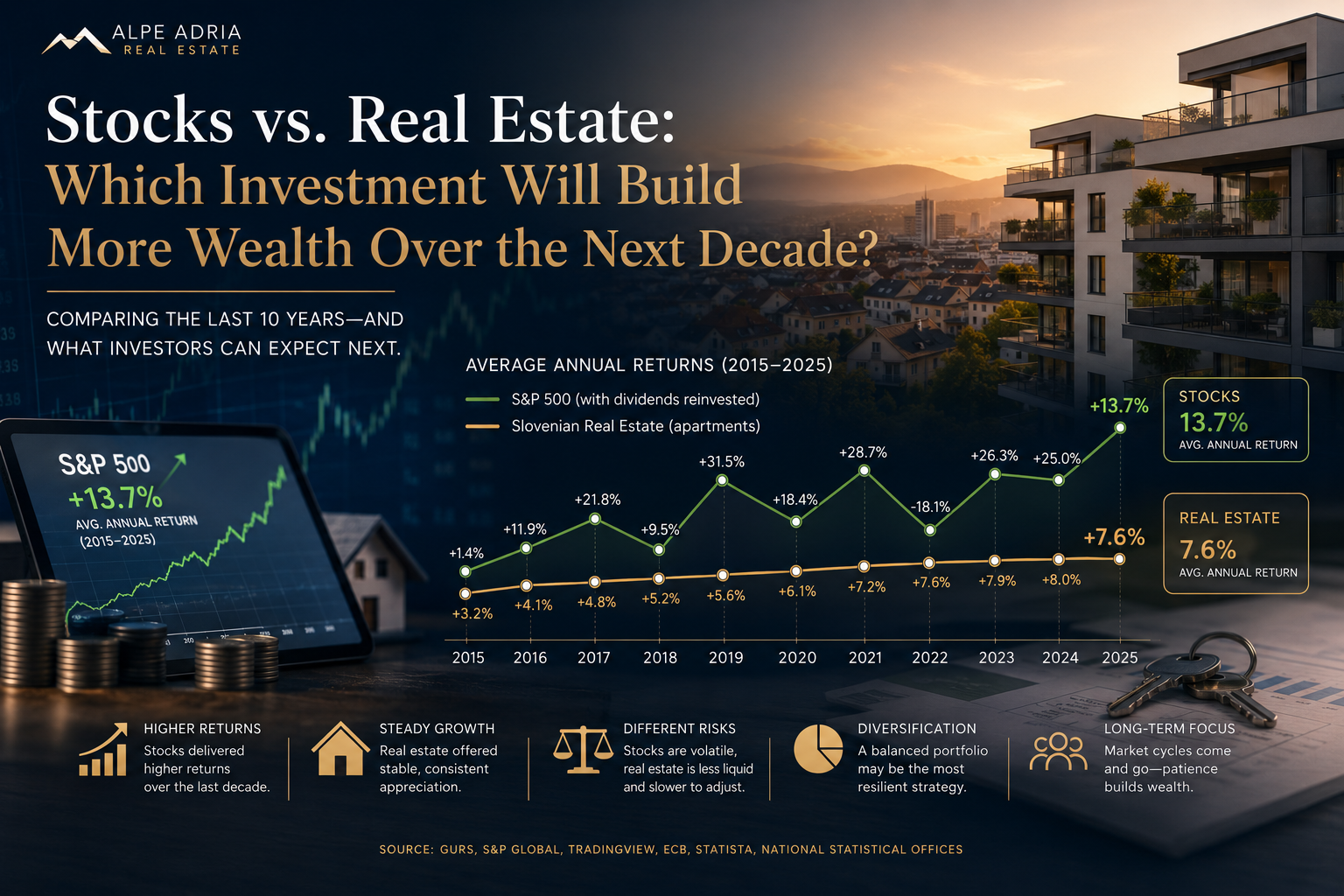
Including reinvested dividends, the index generated an average annual return of 13.7% over the past ten years (through May 2026). This significantly exceeds its long-term historical average of roughly 10.6% over the past century and approximately 10.3% over the last thirty years.
However, long-term averages can be misleading.
If the investment period is shifted only slightly—for example, from the end of 2004 to the end of 2024—the average annual return falls to 8.4%. This illustrates one of the most important lessons in investing: long-term performance depends heavily on the starting point.
Investors who entered the market just before the bursting of the dot-com bubble or ahead of the 2008 financial crisis experienced a dramatically different journey from those who began investing in 2016 or 2019.
The remarkable performance of the last decade was supported by several extraordinary factors:
- explosive growth in large technology companies,
- historically low interest rates,
- massive monetary stimulus following the COVID-19 pandemic,
- and an unusually rapid economic recovery.
These conditions created one of the strongest bull markets in modern history. While impressive, investors should be cautious about assuming that such returns represent the “new normal.”
Slovenia’s Real Estate Market: Slower, But Remarkably Consistent
While U.S. stocks delivered spectacular gains, Slovenia’s residential property market followed a different path—less volatile but highly consistent.
In Ljubljana, the average price of a second-hand apartment increased from approximately €2,040 per square meter in 2015 to around €4,510 today. That represents a price increase of roughly 120%, equivalent to an average annual appreciation of just over 8%.
For a typical apartment, this translates into an increase in market value of approximately €135,000 over ten years.
Detached houses in the capital followed a similar trend, with average prices rising from roughly €207,000 to nearly €405,000 during the same period.
Across Slovenia as a whole, price growth was slightly more moderate. The median price of second-hand apartments increased from approximately €1,450 per square meter in 2015 to around €2,920 in 2024, effectively doubling over the decade and producing annual growth of about 7.3%.
House prices outside the capital also appreciated, although at a slower pace.
Several structural factors explain this sustained growth:
- a persistent shortage of housing supply,
- limited availability of building land,
- lengthy permitting procedures,
- and increasingly long mortgage terms.
Where buyers once financed homes over 10 to 15 years, mortgage maturities of 20 to 30 years have become increasingly common. This reflects a broader reality: for many households, purchasing a home has evolved from a major life milestone into a decades-long financial commitment.
Comparing Stocks and Real Estate: It’s Not That Simple
At first glance, the numbers seem straightforward.
The S&P 500 produced average annual returns of 13.7%, while Slovenian residential real estate generated roughly 7–8% annual appreciation.
Yet comparing these figures directly would be misleading.
Stock market returns are measured in U.S. dollars and typically exclude currency risk for international investors. They also do not account for taxes on capital gains, which vary significantly across jurisdictions.
Real estate returns, on the other hand, usually ignore one of the asset class’s defining characteristics: financial leverage.
Most property purchases are financed with mortgages, allowing investors to control a valuable asset using relatively little equity. When prices rise, leverage can substantially amplify returns. When prices fall, however, it magnifies losses just as quickly.
In addition, headline property appreciation rarely reflects the true cost of ownership.
Maintenance expenses, insurance, property transfer taxes, agency commissions, and renovation costs can easily reduce net returns by 5% to 10% over the life of an investment.
Conversely, rental income can significantly improve overall performance, particularly in markets with strong tenant demand.
For that reason, neither stocks nor real estate should be evaluated solely by looking at price appreciation. Total return—including income, taxes, financing costs, and transaction expenses—provides a far more accurate picture of long-term investment performance.
How Stocks and Real Estate Behave During a Crisis
One of the biggest differences between stocks and real estate becomes apparent during periods of economic stress.
Stock markets tend to react immediately. Prices can fall sharply within days or even hours as investors respond to uncertainty. Real estate markets, by contrast, move much more slowly. Transactions are less frequent, prices adjust gradually, and official statistics often lag behind market conditions by several months.
Stock Markets: Sharp Declines, Fast Recoveries
History shows that stock market corrections are inevitable—but so are recoveries.
When the dot-com bubble burst between 2000 and 2002, the S&P 500 lost approximately 49% of its value. It then took nearly seven years for the index to recover to its previous peak.
The Global Financial Crisis of 2007–2009 proved even more severe. The index declined by roughly 57% over 17 months before eventually recovering over the following four years.
Then came the COVID-19 pandemic.
In early 2020, the S&P 500 fell about 34% in just five weeks—the fastest bear market in modern financial history. Yet it also delivered the fastest recovery ever recorded, regaining its previous highs within only four months as governments and central banks introduced unprecedented fiscal and monetary stimulus.
More recently, 2022 presented investors with a different kind of challenge.
Instead of a sudden crash, rising interest rates and persistent inflation triggered a prolonged decline of around 25% over nine months. There was no dramatic collapse—only a slow, persistent erosion in asset prices. Many investors describe this type of market as psychologically more difficult because losses accumulate gradually without the panic that often accompanies sharp crashes.
Despite their differences, every major downturn has shared one common outcome: the market eventually recovered and moved on to new highs.
One of the costliest mistakes investors make is selling during periods of panic. Historically, many of the strongest daily gains occur shortly after the market reaches its lowest point, meaning investors who exit during a crisis often miss a significant portion of the subsequent recovery.
Real Estate: Slower Corrections, Longer Cycles
Property markets tell a very different story.
Unlike stocks, real estate prices do not adjust instantly because properties are bought and sold far less frequently. Sellers are also generally more reluctant to reduce asking prices, especially when market conditions deteriorate.
Following the Global Financial Crisis, Slovenia’s residential property market entered a prolonged correction. Prices declined for five to six years after peaking in 2008, eventually reaching their lowest levels around 2015 before beginning a new growth cycle.
The COVID-19 pandemic produced a surprising outcome.
While equity markets experienced one of the fastest crashes in history, property markets across Slovenia and much of the region remained resilient. In fact, uncertainty encouraged many investors to shift capital into residential real estate, viewing property as a safer long-term store of value.
This increased demand accelerated price growth instead of slowing it.
When central banks raised interest rates during 2022 and 2023, housing transactions declined as mortgages became more expensive. However, official prices in Slovenia and Croatia continued to rise, albeit at a slower pace.
The pattern was clear:
- Stock markets reacted immediately.
- Property markets adjusted gradually.
- Transaction volumes fell long before prices showed any significant weakness.
In other words, stocks tend to experience deeper but shorter declines, whereas real estate often undergoes milder corrections that can result in years of stagnant prices.
What Can Investors Expect Over the Next Decade?
Forecasting financial markets is never straightforward, but most long-term analysts agree on one point: the exceptional returns of the last decade are unlikely to be repeated.
Outlook for the S&P 500
Today’s U.S. equity market trades at historically elevated valuations, particularly within the technology sector.
As a result, many investment strategists expect long-term annual returns to normalize toward historical averages.
Rather than the 13–14% annual gains investors have recently enjoyed, a more realistic expectation for the coming decade lies somewhere between 7% and 10% per year.
That would still represent attractive long-term growth—but considerably below the extraordinary performance experienced since 2016.
Outlook for Real Estate
Residential property markets across Slovenia and much of Southeast Europe are also expected to cool.
Instead of annual appreciation ranging from 6% to 11%, future growth is likely to settle closer to 3% to 6%, assuming no major financial crisis occurs.
Several structural factors continue to support housing prices:
- limited housing supply,
- slow construction and permitting processes,
- ongoing urbanization,
- and continued migration toward larger cities.
At the same time, affordability has deteriorated significantly.
In Ljubljana, purchasing a typical 70-square-meter apartment now requires nearly twelve years of average gross salaries, placing the Slovenian capital among Europe’s least affordable cities for homebuyers.
This limits how much further prices can rise without corresponding wage growth.
Another Crisis Is Not a Question of If—but When
History suggests that investors should expect at least one major downturn during any ten-year investment horizon.
Since 1929, Wall Street has experienced a bear market roughly every seven years on average.
If history repeats itself, the S&P 500 could experience another temporary decline of 25% to 50% before eventually recovering, as it has after every major market correction over the past century.
Property markets would likely respond differently.
Instead of an immediate collapse, they would probably experience lower transaction volumes, slower price growth, and possibly a gradual correction similar to the period between 2009 and 2014.
The decline might be smaller in percentage terms than that of equities, but weaker liquidity could leave property prices stagnant for several years.
Stocks vs. Real Estate: Pros and Cons
Advantages of Investing in Stocks
Stocks offer exceptional liquidity. Investors can buy or sell diversified portfolios within seconds, often at very low transaction costs.
An index fund tracking the S&P 500 provides exposure to hundreds of leading global businesses, reducing company-specific risk while requiring virtually no maintenance.
The downside is volatility.
Stock prices fluctuate daily, sometimes dramatically. Emotional reactions during market downturns often lead investors to sell precisely when patience would have produced better long-term results.
International investors must also consider currency risk, as returns depend not only on stock performance but also on exchange-rate movements.
Advantages of Investing in Real Estate
Real estate offers something stocks generally cannot: leverage.
Through mortgage financing, investors can control a high-value asset using relatively modest personal capital. Rental income can further enhance long-term returns while providing regular cash flow.
These benefits come with significant trade-offs.
Property is illiquid, transactions are expensive, and investments are concentrated in a single location. Maintenance costs, taxes, insurance, and unexpected repairs all reduce profitability.
Perhaps most importantly, leverage works both ways.
While rising prices can multiply gains, falling prices can quickly eliminate an investor’s equity, leaving debt that exceeds the property’s market value.
Regional Perspective: Property Markets Across Southeast Europe
While Slovenia’s housing market has experienced remarkable growth over the past decade, it is far from the only success story in the region. Croatia, Serbia, and Montenegro have all seen significant increases in residential property prices, although each market has been driven by a unique combination of economic, demographic, and investment factors.
Understanding these regional trends provides valuable context for investors considering opportunities beyond their domestic market.
Slovenia: Stable Growth in a Supply-Constrained Market
Ljubljana remains Slovenia’s most expensive and most liquid residential property market.
Average prices for second-hand apartments have climbed to approximately €4,500 per square meter, representing annual growth of around 8% over the past decade.
The country’s coastal region—including Koper, Piran, and Portorož—has also become one of the most desirable locations for residential investment. Interestingly, average prices along Slovenia’s Adriatic coast are now higher than those in many comparable Croatian coastal markets, reaching roughly €3,770 per square meter.
Limited land availability, strict planning regulations, and consistently strong demand continue to support prices despite higher borrowing costs.
Croatia: One of Europe’s Fastest-Growing Housing Markets
Croatia has emerged as one of the strongest-performing residential property markets in the European Union.
Between 2015 and the third quarter of 2025, average residential property prices increased by approximately 130%, making Croatia one of the six fastest-growing housing markets in the EU.
Along the Adriatic coast—including Istria, Kvarner, and Dalmatia—average apartment prices now range between €3,500 and €3,600 per square meter.
Demand has been fueled by several factors:
- international buyers,
- tourism-driven investment,
- improved infrastructure,
- and Croatia’s accession to the euro area and the Schengen Zone.
Slovenian citizens remain the largest group of foreign property buyers in Croatia. Last year alone, they purchased 3,403 residential properties, while demand from Slovenian buyers increased by approximately 20% compared with the previous year.
Serbia: Rapid Expansion Led by Belgrade
Belgrade has experienced one of the region’s most dynamic property booms.
New Belgrade, one of the capital’s fastest-growing districts, has seen average apartment prices rise from approximately €1,200–1,300 per square meter in 2015 to between €2,600 and €3,500 today, depending on the neighborhood and property type.
Even more striking is the transformation of Belgrade Waterfront.
What began as a large-scale redevelopment project has become Serbia’s benchmark for premium residential real estate. Average apartment prices now range between €5,000 and €5,800 per square meter, while some luxury transactions have exceeded €15,000 per square meter.
According to local market reports, residential prices in Belgrade nearly doubled between 2020 and 2025 alone, highlighting how strongly demand accelerated during the second half of the decade.
Unlike more mature European markets, Belgrade’s housing sector remains highly cyclical. Market slowdowns typically appear first through declining transaction volumes rather than significant price reductions.
Montenegro: A Small Market with International Appeal
Montenegro’s Adriatic coastline has evolved from a niche holiday destination into one of Southeast Europe’s fastest-growing luxury real estate markets.
Budva, Kotor, and Tivat have become the country’s premier investment locations, attracting buyers from across Europe and beyond.
Average coastal property prices are now around €2,500 per square meter, while the national average reached approximately €2,910 per square meter during the first quarter of this year—an increase of 8.5% compared with the previous year.
Since 2018, prices along the coast have risen at an average annual rate of roughly 5%.
Although this growth has been slower than in Croatia or Belgrade, it has also been more consistent.
One additional factor continues to support investor optimism: Montenegro’s long-term ambition to join the European Union. Many analysts believe that further integration with the EU could strengthen demand for coastal property and improve long-term investment prospects.
In the premium segment, many market participants expect luxury waterfront developments to remain resilient even during weaker global economic conditions, as they increasingly attract international wealth seeking stable, lifestyle-oriented investments.
Final Thoughts: Which Investment Is Better?
The past decade rewarded investors in both stocks and real estate—but for entirely different reasons.
The stock market benefited from one of the strongest bull runs in history, supported by technological innovation, abundant liquidity, and exceptionally accommodative monetary policy.
Real estate, meanwhile, was driven by structural housing shortages, demographic trends, historically low borrowing costs, and strong demand across many European markets.
Looking ahead, expectations should be more measured.
Both asset classes are likely to continue generating positive long-term returns, but neither is expected to repeat the extraordinary performance of the past ten years.
Equity markets face higher valuations and the likelihood of lower future returns.
Property markets face affordability constraints, rising financing costs, and slower price appreciation after years of rapid growth.
Most importantly, every investor should recognize that market cycles are inevitable.
Another recession or financial crisis will occur—it is simply impossible to know exactly when. Stocks may decline sharply but have historically recovered relatively quickly. Real estate corrections are usually slower and less dramatic, yet periods of stagnation can last for years.
Ultimately, the decision between stocks and real estate is not purely a mathematical one.
It depends on an investor’s financial situation, investment horizon, tolerance for risk, liquidity needs, and personal objectives.
For many investors, the most resilient strategy may not involve choosing one asset class over the other, but combining both. A diversified portfolio that includes financial assets alongside real estate has historically provided a balance of growth, income, and risk management across different economic cycles.
Disclaimer: This article is intended for informational purposes only and should not be considered financial, investment, legal, or tax advice. Investors should consult qualified financial or tax professionals before making significant investment decisions.