Few homebuyers realize that a change in the interest rate of just 0.25 percentage points over two decades can make a difference equivalent to the value of a used car – yet that is exactly what is happening to thousands of borrowers who have signed mortgage agreements in recent years.
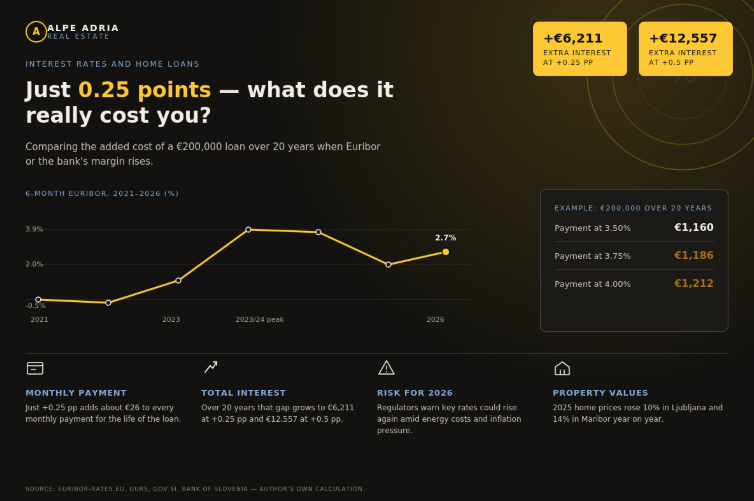
Take a typical example: a €200,000 mortgage with a 20-year repayment period and an annual interest rate of 3.5% – a combination of Euribor, which has hovered at just over 2% in recent months, and the bank’s margin. Under these conditions, the monthly payment is approximately €1,160, while the total amount paid to the bank over the entire period rises to around €278,400, of which €78,400 is interest alone.
Now increase the interest rate by 0.25 percentage points, to 3.75% – whether due to a rise in Euribor or a higher bank margin when renewing the contract or switching providers. The monthly payment rises to approximately €1,186, which is €26 more per month. At first glance, that may seem negligible, but over the entire repayment period it means an additional €6,200 in interest. If the rate rises by 0.5 percentage points, to 4%, the monthly payment increases to €1,212, while the total additional burden reaches almost €12,500. That is an amount many families might otherwise spend on renovating a bathroom.
This sensitivity is not theoretical. The six-month Euribor was still negative in mid-2021, at around minus 0.5%, but then began to rise sharply as the European Central Bank tightened monetary policy in 2022, reaching almost 4% by the end of 2023 – its highest level in more than a decade. Since then, the trend has reversed: by the beginning of 2026, Euribor had fallen to around 2%, providing borrowers with significant relief on their monthly payments. Currently, the six-month Euribor is around 2.7 percentage points. The question is how long this pause will last. In its latest analysis, the Surveying and Mapping Authority warns that geopolitical uncertainty, rising energy prices and renewed inflationary pressures in 2026 could trigger another increase in key interest rates – which would directly affect Euribor and, consequently, the payments on new and variable-rate mortgages.
Lower interest rates have also partly fueled the property market over the past two years. After transaction volumes fell in 2022 and 2023, the number of residential property transactions increased by 30% in the first half of 2025 compared with the second half of 2024, while prices continued to rise. The median price of a used apartment nationwide exceeded €3,000 per square meter for the first time, while in Ljubljana it came close to €4,900. Among the major cities, Maribor recorded the highest annual price growth in 2025, at 14%, followed by Kranj at 12% and Ljubljana at 10%. Lower interest rates therefore do not necessarily mean greater purchasing power – increased demand for cheap money often pushes property prices up faster than mortgage payments fall, meaning buyers may ultimately be able to afford a similar or even smaller property than before interest rates declined.
What does this mean in practice for an apartment purchased for €250,000, with €50,000 in savings and a €200,000 mortgage at an interest rate of 3.5% over 20 years? The total amount that will leave the buyer’s pocket over those 20 years – the down payment plus all mortgage payments – comes to approximately €328,400. That is the real cost of owning the property, before even considering its future value.
If we assume moderate, long-term sustainable property price growth of between 3% and 4% per year – considerably slower than the record double-digit increases of the past two years – such a property could be worth between approximately €450,000 and €550,000 in 20 years. The difference between the €328,400 invested and the property’s future value may look like a healthy return, but the figure is misleading if viewed in isolation.
The calculation does not include a single euro of depreciation-related costs, ongoing maintenance, roof replacement, heating system upgrades, new windows or bathroom renovations – all of which every property inevitably needs over the decades to maintain, let alone increase, its value. Over two decades, these costs can amount to tens of thousands of euros, depending on the condition of the building and the scale of renovations. It therefore makes sense to take a few minutes and calculate for yourself how much you have actually spent on your property and how much more you will have to invest in it to keep it worth as much as the optimistic projection suggests. With a mortgage lasting two decades, every euro counts.