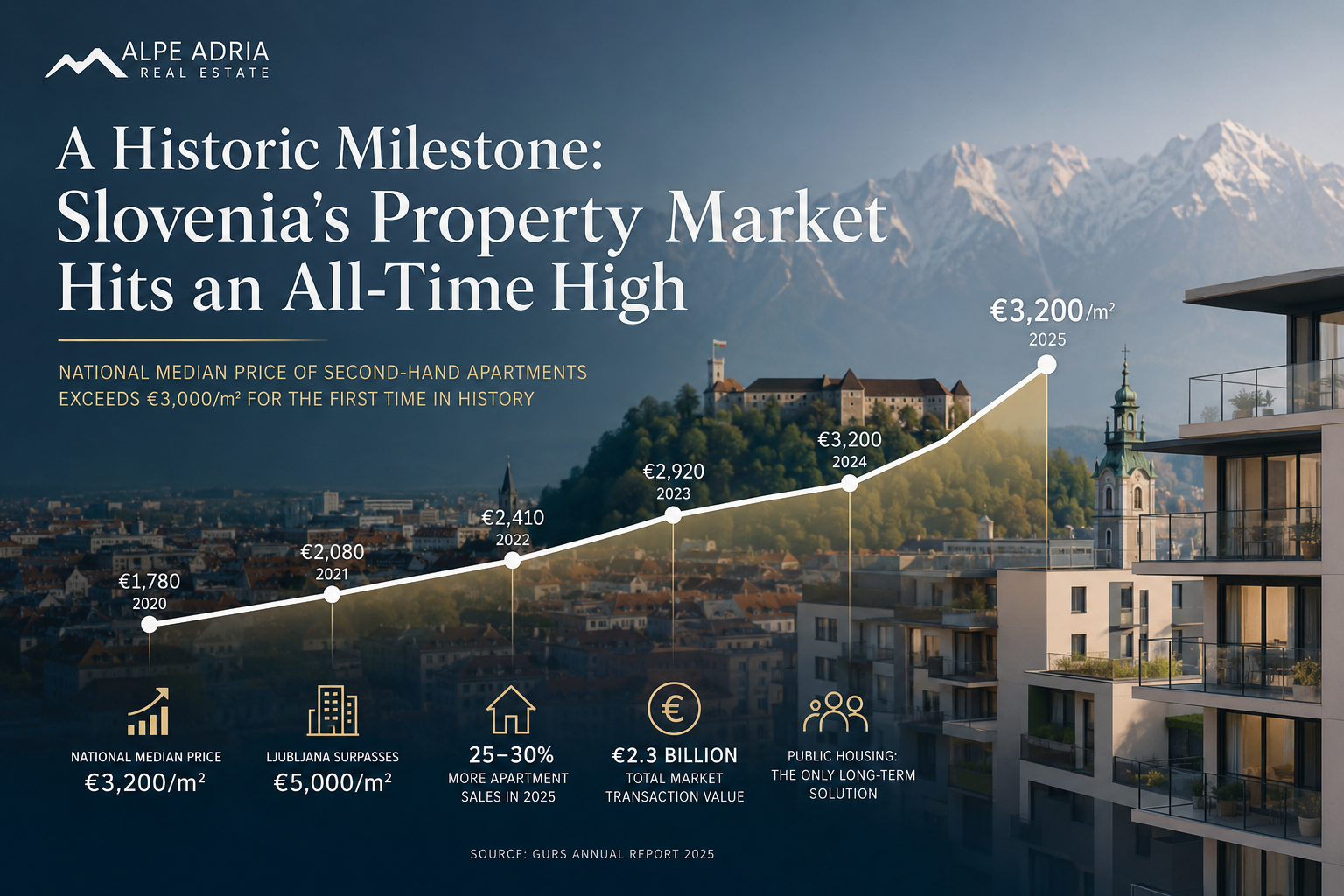
Slovenia’s real estate market reached a turning point in 2025 that experts had been predicting for years, though many had hoped it would not arrive so soon. The Surveying and Mapping Authority of the Republic of Slovenia (GURS) confirmed in its annual report for 2025 that the median price of a second-hand apartment at the national level has — for the very first time in history — broken through the €3,000 per square metre barrier, reaching precisely €3,200/m². At the same time, Ljubljana crossed the symbolic threshold of €5,000/m² for the first time. These are not just numbers — they are a mirror of the era we are living in.
Table of Contents
- The Market That Refused to Cool Down
- Record Prices Across the Country
- Maribor: A Surprising Surge
- Regional Disparities: From €1,500 to €9,700/m²
- The Long-Term Trend: From 2020 to Today
- Record Transactions and Market Value
- Outlook for 2026: Cooling Off or Another Record?
- Public Housing: The Only Long-Term Solution?
The Market That Refused to Cool Down
In recent years, forecasts of a cooling Slovenian property market were plentiful. Rising interest rates, more expensive loans and general economic uncertainty had given many hope that the sales momentum would ease. Reality told a different story. The year 2025 brought a genuine revival: the number of apartment sales in multi-family buildings increased by 25 to 30 percent compared to 2024, while sales of residential houses rose by 20 to 25 percent. After three consecutive years of declining transaction volumes, the market came back with force.
The key driver of this turnaround was falling interest rates, which made mortgage lending more accessible. High employment levels and real wage growth further reinforced buyer confidence. Together, these factors created conditions for surging demand — which supply, it seems, simply cannot keep pace with.
Record Prices Across the Country
GURS finds that apartment and house prices have reached new all-time highs virtually everywhere in Slovenia. The national median for second-hand apartments reached €3,200/m², which is €280 more than the previous year. But this is only an average that conceals an extraordinary spread between regions.
Ljubljana firmly holds the top of the rankings, with the median price crossing €5,000/m² for the first time — representing an annual increase of €540/m². In certain parts of the capital, particularly Trnovo and the city centre, second-hand apartments changed hands for as much as €12,300/m². The record transaction of 2025 was an apartment in Villa Schellenburg — 150 square metres sold for just over €1.9 million.
Close behind Ljubljana on the most expensive locations list is the Slovenian Coast (Koper, Piran, Portorož, Izola, Ankaran), with a median price of €4,810/m². Notably, Ankaran reached a record median of €5,480/m², placing it among the most exclusive locations in the country. The coast also saw the priciest studio apartment of 2025 sold — 27 square metres at €10,000/m² — and the region’s most expensive house, a 1974-built property, for over €1.5 million.
Third place among the most expensive areas goes to the Alpine tourist destinations — Kranjska Gora, Bled and the Bohinj Lake area — with a median price of €4,530/m². This region recorded the largest annual price jump in the entire country: a remarkable €710/m² in a single year.
Maribor: A Surprising Surge
Slovenia’s second-largest city recorded an impressive 14 percent price increase in 2025 — the highest among all major Slovenian cities. The median price of a second-hand apartment in Maribor reached €2,670/m², nearly €400 more than the year before and for the first time above the €2,600/m² mark. Nevertheless, prices in Maribor remain roughly half those in Ljubljana on average — giving the city a certain relative appeal for buyers priced out of the capital.
The most expensive apartment sold in Maribor was a studio in the city centre, which achieved just over €5,500/m² — a figure that, not long ago, would have been associated exclusively with the Ljubljana market.
Regional Disparities: From €1,500 to €9,700/m²
One of the key findings of the GURS report is the extraordinary price dispersion within a single country. While the capital and the coast command prices comparable to Western European cities, some regions remain affordable:
- Bela krajina and Posavje — median prices below €1,500/m², the cheapest area in the country
- Haloze — the most affordable houses, with a median price of €75,000
- Zasavje and the northern Ljubljana suburbs — recorded the highest annual growth at 16 percent
- Kranj and surroundings — 12 percent growth, moderate but steadily rising prices
- The Coast — the lowest regional growth rate (8%), yet starting from an already high base
The national median price for a residential house with land reached €182,000 — €17,000 more than the previous year. The most expensive houses are in Ljubljana (median price €460,000), while the cheapest are in Haloze and Bela krajina.
The Long-Term Trend: From 2020 to Today
The GURS report confronts us with the uncomfortable reality of the long-term trajectory. From the onset of the Covid-19 pandemic in 2020 to 2025:
- Apartment prices rose by nearly 80 percent
- House prices increased by 65 percent
- Building land prices climbed by nearly 60 percent
- Construction costs rose by nearly 50 percent over the same period
This means that property values grew significantly faster than construction costs — suggesting that prices are not driven solely by more expensive building, but by a structural imbalance between supply and demand. GURS explicitly stresses that high housing prices prevent the majority of the population from accessing decent housing in a normal way, which under the constitution is a fundamental right of every citizen.
Record Transactions and Market Value
In 2025, according to GURS preliminary estimates, approximately 9,500 apartments in multi-family buildings and around 5,900 residential houses were sold. The total value of apartments sold came to €1.324 billion, while residential houses accounted for €952 million — meaning the residential property market generated close to €2.3 billion in transaction value alone.
At the end of 2025, Slovenia had over 556,000 registered residential houses and approximately 354,000 apartments in multi-family buildings. The total value of the entire Slovenian real estate stock stands at around €297 billion.
Outlook for 2026: Cooling Off or Another Record?
GURS warns that conditions for 2026 are uncertain. Geopolitical tensions, potential further increases in energy prices and inflationary pressures could trigger a renewed rise in interest rates — which would reduce the number of transactions and at least slow the rate of price growth. Yet GURS is equally clear: barring a severe global economic crisis, a meaningful decline in prices is not to be expected. The market is structurally imbalanced and a short-term downward correction appears unlikely.
Public Housing: The Only Long-Term Solution?
GURS emphasises in its report that building public housing is a long-term necessity — one that cannot be avoided. Without systematic provision of affordable homes for the broader population, rising prices will only deepen social inequality and exclude an ever-growing share of residents from property ownership. The report also flags the inadequate documentation of the rental market and new-build sales — areas where legislation exists but is not consistently enforced.
Source: Annual Report of the Surveying and Mapping Authority of the Republic of Slovenia (GURS) on the Slovenian Real Estate Market for 2025, published May 2026. Summarised and edited for Alpe Adria Real Estate.